


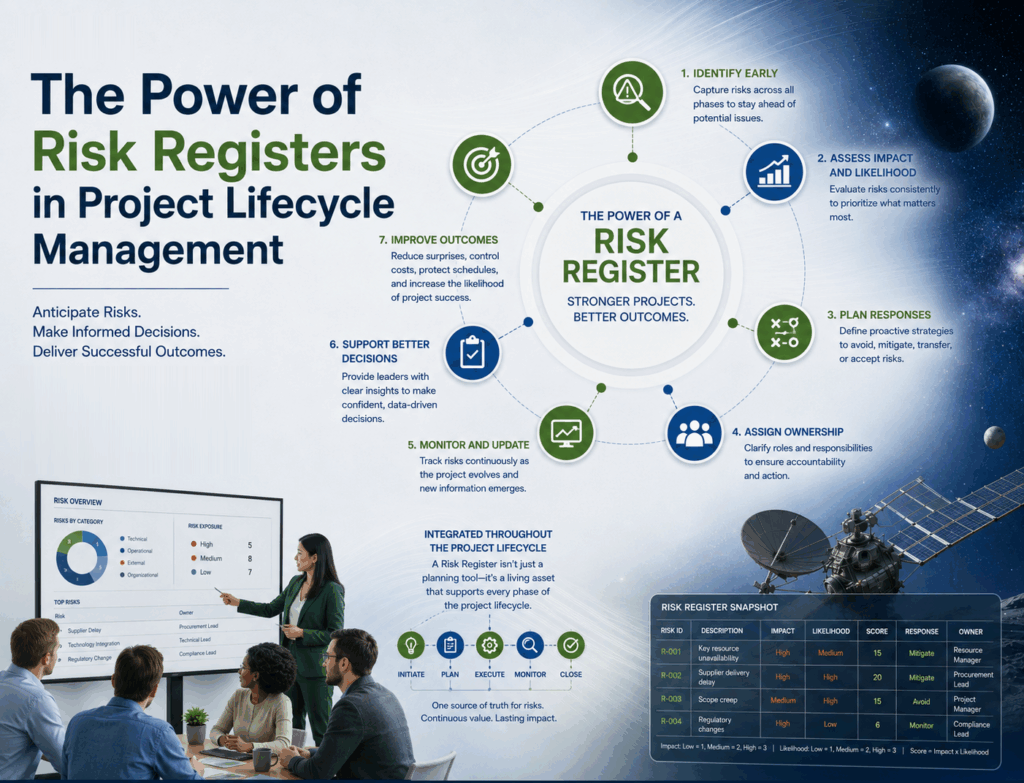
Every major project begins with a plan. Timelines are set, budgets are approved, and teams are assembled with a shared vision of what success looks like. But between the kickoff meeting and the ribbon cutting, something always happens. Schedules slip. Costs creep. Technical assumptions prove wrong. The question is never whether risks will materialize, it is whether your team saw them coming and had a plan when they did.
That is the core value of a risk register. Not paperwork. Not compliance theater. A genuine operational tool that keeps project leadership informed, accountable, and ahead of the curve.
What a Risk Register Actually Does
At its simplest, a risk register is a structured log of every identified risk on a project, paired with the information your team needs to assess, track, and respond to each one. But that description undersells it.
A well-maintained risk register is the connective tissue between project planning and project reality. It captures not just what could go wrong, but how likely it is, what the cost and schedule impact would be, who owns it, and what the team is doing about it. That combination of visibility and accountability is what separates projects that manage risk from projects that react to it.
For complex scientific, technology, and major construction projects, where the work itself is often first-of-a-kind, a risk register is not optional. It is foundational.
Risk Registers Across the Project Lifecycle
One of the most important things to understand about a risk register is that it is not a one-time deliverable. It is a living document that evolves with the project. Its value changes depending on where you are in the lifecycle.
Planning and Baseline
In the early phases, the risk register drives honest conversation about what is unknown. It forces the project team to look ahead, identify assumptions that could prove wrong, and estimate the cost and schedule impact of those scenarios before the baseline is locked. Risks captured at this stage directly inform contingency requirements and inform how the performance measurement baseline is structured.
Execution
During execution, the register becomes a monitoring and accountability tool. Risks move through status changes, new risks emerge as work progresses, and mitigation actions either close out or escalate. Regular risk reviews, supported by the register, ensure that nothing drifts into crisis without warning. The audit trail built into a well-maintained register also protects the project team when questions arise about when a risk was identified and what actions were taken.
Reporting and Stakeholder Communication
Leadership and sponsors need a clear, honest picture of project risk exposure without wading through every line of the register. Heat maps, summary dashboards, and top-risk reports translate the register into communication-ready formats. Cost and schedule risk quantification, particularly through Monte Carlo simulation, allows the team to present statistically grounded contingency recommendations rather than gut-feel estimates.
Closeout
At project completion, the risk register becomes institutional knowledge. Which risks materialized? Which mitigations worked? Which categories of risk were consistently underestimated? That information is invaluable for the next project, and it only exists if the register was maintained throughout.
The Limitations of a Spreadsheet-Based Register
Many project teams start with a spreadsheet. It is fast to set up, familiar to everyone, and requires no new software. For small projects with a handful of risks and a stable team, it can be sufficient.
But as project complexity grows, spreadsheet-based risk registers hit real limits.
Version control becomes a problem. When the register lives in a shared drive, it is never clear whether you are looking at the current version. Audit history disappears. Ownership gets murky. And when it comes time to run a Monte Carlo simulation or produce a heat map for a management review, the work of getting from the register to the output is manual, time-consuming, and error-prone.
More fundamentally, a spreadsheet register is disconnected from the rest of the project. It does not know what your schedule looks like, what your cost baseline is, or how your contingency is being consumed. That disconnection means the register is always a step behind the project, updated in bursts rather than maintained continuously.
What an Integrated Risk Register Changes
When the risk register is integrated into the same platform as your cost, schedule, and earned value data, the value proposition shifts significantly.
Risk is no longer a separate workstream maintained by a separate team. It is woven into how the project is managed day to day. Cost and schedule impacts are evaluated in the context of the actual baseline, not a separate spreadsheet estimate. Monte Carlo simulations draw from real risk data and real schedule structure. Heat maps and driver analysis surface automatically from the register, without manual compilation.
For project controls professionals, this integration means less time assembling reports and more time analyzing what the reports are telling you. For project leadership, it means a consistent, trustworthy picture of risk exposure at every review cycle.
Key Features of an Effective Risk Register
Whether you are evaluating a purpose-built risk management platform or building out your own approach, the following capabilities define a risk register that genuinely supports project lifecycle management.
Structured, consistent logging. Every risk should be captured with a standard set of fields: ID, title, description, category, type, probability, cost impact, schedule impact, handling strategy, and owner. Consistency across the register is what makes filtering, sorting, and reporting reliable.
Owner accountability. A risk without an owner is a risk without a plan. Assigning named risk owners and action owners ensures that every risk is actively managed, not just documented.
Mitigation and response tracking. The register should capture not just the risk, but the response. Treatment strategies, action plans, target dates, and response status should all live alongside the risk record so the team can see at a glance whether mitigations are on track.
Heat map visualization. Plotting risks by probability and impact across cost, schedule, and overall ranking gives leadership an immediate read on where exposure is concentrated. The ability to configure the ranges and thresholds to match your project’s risk tolerance is essential.
Monte Carlo simulation. Quantitative risk analysis should be accessible without a separate tool or a specialist to run it. Native Monte Carlo simulation for both cost and schedule risk, with the ability to compare pre- and post-mitigation scenarios, gives the project team a defensible basis for contingency recommendations.
Key risk driver identification. Knowing your top risks is useful. Knowing which specific risks and schedule activities are driving the most exposure is actionable. Driver analysis focuses mitigation effort where it will have the greatest impact.
Full audit history. Every change to every risk should be logged, with a timestamp and the identity of who made the change. This is not just good governance, it is protection for the project team when questions arise after the fact.
Excel compatibility. Risk data needs to travel. One-click export to Excel ensures that the register can feed reporting, reviews, and stakeholder communications without friction.
Risk Management Is a Discipline, Not a Document
The projects most likely to succeed are not the ones with the most detailed risk register at kickoff. They are the ones where risk management is practiced consistently throughout the lifecycle, where risks are reviewed regularly, mitigations are tracked honestly, and the data from the register actually influences decisions.
A good risk register makes that discipline easier to sustain. It lowers the friction of staying current, raises the visibility of what matters most, and gives the team the quantitative tools to communicate risk exposure with confidence.
For projects pushing the boundaries of what has been done before, that discipline is not a nice-to-have. It is how you get to the finish line.