

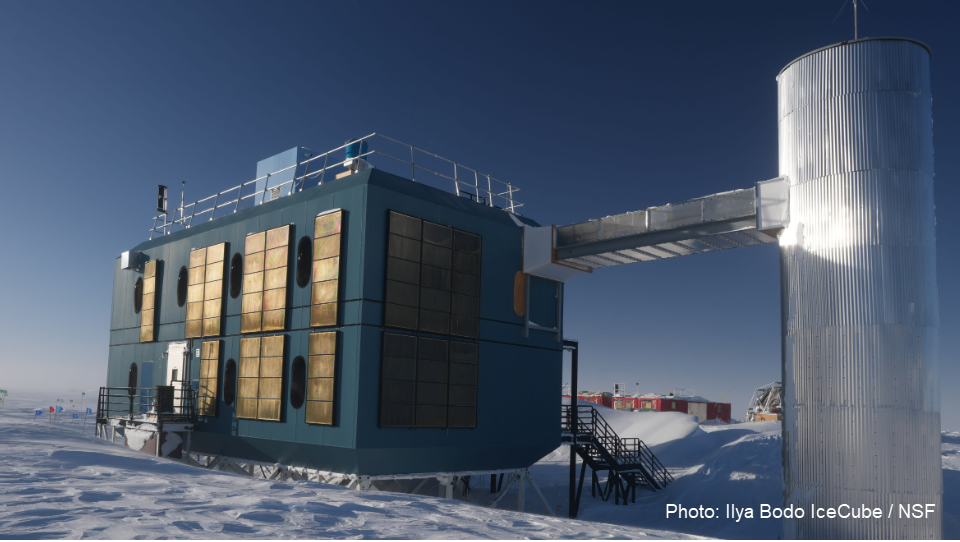
A mile and a half beneath the Antarctic ice, one of the most ambitious scientific instruments ever built listens for the faintest signals from the edges of the universe. The IceCube Neutrino Observatory does not look like much from the surface. A few buildings. Some equipment. Miles of frozen emptiness in every direction. But deep below, a full cubic kilometer of instrumented ice waits for neutrinos that have traveled billions of light-years to pass through it.
Approved for funding by NSF in 2019, the IceCube Upgrade represented the first significant expansion of the observatory since its original completion, adding five new densely instrumented strings of light sensors deep beneath the Antarctic ice and deploying more than 500 new and enhanced sensors and calibration instruments. The project required three consecutive field seasons at the South Pole, international coordination across institutions in the US, Germany, Japan, Sweden, Taiwan, and beyond, and around-the-clock drilling operations using the largest hot water drill system in the world. Running a project like that requires more than good science. It requires a team of highly skilled technical experts backed by sound project management and efficient project controls, so the focus stays where it belongs, on executing the mission.
The Challenges
Four years into the IceCube Upgrade, the Project Management Controls System (PMCS) was not keeping pace with the project. The team had been managing cost, schedule, and earned value reporting in Smartsheet, but the implementation lacked the foundational elements of a truly integrated cost and schedule system. The result was a project in constant effort to satisfy NSF’s requirements rather than focusing on the technical mission. Critical path analysis lacked credibility, the cost and schedule baseline did not meet NSF’s expectations, earned value reporting did not instill confidence, and change control of the performance measurement baseline had significant gaps.
It was determined that the project required a rebaseline of cost, schedule, and earned value reporting. The team needed a clean reset on the right foundation, not just better tools, but a formal project controls system with the processes and discipline to match. Dash360 was engaged to support that effort, and given their experience on MREFC and Mid-Scale NSF projects, they were a natural fit. In less than 60 days the integrated master schedule was complete and loaded into Dash360, with the official rebaseline approved by NSF weeks later. With four years of execution still ahead, the project had the foundation it needed to execute, measure performance, manage change, and keep the focus where it belonged, on the science.
The Solution
Because much of the underlying cost data was already at a useful level of detail, it could be imported into Dash360 in a straightforward manner. The primary focus of the implementation became the schedule, and the monthly processes required to update it in a way that produced credible earned value performance data.
With project leadership and CAMs fully engaged, Dash360 worked closely with the project team to redefine how cost, schedule, and earned value management would be handled going forward. Dash360 built out the PMCS around the existing cost foundation, established an integrated schedule baseline, stood up a structured change control process, and implemented a repeatable monthly update cycle supporting NSF-compliant earned value reporting. Dash360 conducted Control Account Manager training to ensure the project team had the knowledge and discipline to sustain credible earned value performance measurement through project completion, and provided ongoing project controls support throughout.
Results
Every successful implementation comes down to the same ingredients: commitment, expert teams on both sides, the right processes, and the right tools. The IceCube Upgrade had committed leadership and subject matter experts willing to embrace change mid-stream. Dash360 brought the processes and tools to make it work.
In less than three months from engagement, the IceCube Upgrade held a formal review with NSF. The outcome was clear. A project that had spent four years without a credible earned value system was now operating with an integrated performance measurement baseline, a functioning change control process, and the monthly reporting discipline NSF required. The project controls engagement itself came in significantly under budget.
Why work with Dash360
Implementing project management control systems on complex scientific, technology, and major construction projects is what Dash360 does. With a proven track record and a clear blueprint for success, we bring the consulting expertise and integrated software platform to handle the complexity of project controls, so your technical team can stay focused on the mission.